
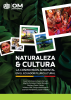
Naturaleza y cultura: la cosmovisión ambiental en el Ecuador pluricultural
Palabras clave:
Cosmovisión Ambiental, Biodiversidad biocultural, Saberes ancestrales, Justicia ecológica, Pluralismo epistémicoSinopsis
El libro examina la cosmovisión ambiental en el Ecuador, país caracterizado por su riqueza biológica y diversidad cultural, donde pueblos indígenas, afrodescendientes y campesinos han configurado históricamente formas de vida vinculadas a sus territorios. A través de un enfoque interdisciplinario, se analizan los fundamentos conceptuales de la naturaleza como construcción socioecológica, cultural e histórica, y se explora el papel de las cosmologías andinas, amazónicas y afroecuatorianas en la organización de prácticas, saberes y sistemas de gobernanza. Los autores abordan marcos teóricos críticos como el pluriverso, las epistemologías del Sur y la decolonialidad, mostrando cómo los conocimientos locales constituyen alternativas frente al extractivismo y aportan estrategias para la sostenibilidad. Asimismo, se presentan estudios de caso sobre conflictos socioambientales y experiencias comunitarias, junto con la incorporación de los derechos de la naturaleza en la Constitución ecuatoriana de 2008. En conjunto, la obra ofrece una visión integral que articula justicia ecológica y justicia cognitiva, aportando al debate contemporáneo sobre sostenibilidad y pluralismo epistémico.
Descargas
Los datos de descarga aún no están disponibles.
Referencias
Acosta, A. (2017). Buen vivir: Rethinking the world from the perspective of buen vivir. In Degrowth in Movement(s) (pp. 58–63). Konzeptwerk Neue Ökonomie. https://base.socioeco.org/docs/dim_buen-vivir.pdf SocioEco
Agoglia, O. (2018). Los aportes de la ecología política latinoamericana al pensamiento ambiental crítico. Revista CISAP, Universidad de Catania.
Allen, C. J. (2002). The Hold Life Has: Coca and Cultural Identity in an Andean Community (2nd ed.). Smithsonian Institution Press. https://www.smithsonianbooks.com/product/the-hold-life-has/
Álvarez, J., & Piloso, L. (2021). Manejo comunitario del manglar en la costa ecuatoriana: desafíos y oportunidades. Revista de Estudios Ambientales, 9(2), 45–62. https://doi.org/10.17141/rea.9.2021.5121
Anderson, E. P., et al. (2018). Fragmentation of Andes-to-Amazon connectivity by hydropower dams. Science Advances, 4(1), eaaq1642. https://doi.org/10.1126/sciadv.aao1642 Science
Aristóteles. (1996). Física (W. D. Ross, Trad.). Clarendon Press. (Original publicado ca. 350 a. C.).
Arnold, D. Y., & Spedding, A. (2005). Ritos y tradiciones de la primera siembra: Ritos agrícolas y estructura social en los Andes. Plural Editores. https://plural.bo/
Beltrán-Conlag, A. C., Licuy-Chimbo, M., López-Grefa, Z. M., & Abril-Saltos, R. (2025). Capacidad de infiltración de especies forestales en la cuenca alta del río Pindo, Amazonía ecuatoriana. Revista Científica Zambos, 4(1), 376-386. https://doi.org/10.69484/rcz/v4/n1/96
Berger, P. L., & Luckmann, T. (1966). The social construction of reality: A treatise in the sociology of knowledge. Penguin. https://amstudugm.files.wordpress.com/2011/04/social-construction-of-reality.pdf amstudugm.files.wordpress.com
Berkes, F. (2012). Sacred Ecology (3rd ed.). Routledge. https://doi.org/10.4324/9780203123195
Boelens, R. (2015). Water, Power and Identity: The Cultural Politics of Water in the Andes. Routledge. https://doi.org/10.4324/9781315685528
Bogert, J. M. (2022). Fabricating nature: a critique of the social construction of nature. Ecology and Society, 27(2), art. 7. https://doi.org/10.5751/ES-13688-270207
Cabrera, O., Duque, A., Peña, J., Cabrera, E., & Cabrera, J. (2019). Geomorphology and altitude effects on the diversity of tropical montane forests: A case from Ecuador. Diversity, 11(3), 32. https://doi.org/10.3390/d11030032 MDPI
Caldas, B., et al. (2023). Identifying the current and future status of freshwater connectivity corridors in the Amazon Basin. Conservation Science and Practice, 5(11), e12853. https://doi.org/10.1111/csp2.12853 Conservation Biology
Calderón-Contreras, R. (2013). Ecología política: hacia un mejor entendimiento de los conflictos socioambientales. Revista Mexicana de Sociología, 75(2). Recuperado de SciELO México.
Carr, L. A., & Bruno, J. F. (2018). Temperature influences herbivory and algal biomass in the Galápagos Islands. Frontiers in Marine Science, 5, 279. https://doi.org/10.3389/fmars.2018.00279 Frontiers
Carrión-Paladines, V., Farley, K., Hofstede, R., & Carrillo-Rojas, G. (2022). Conversion of Andean montane forest to exotic plantations alters biodiversity and ecosystem services. Forest Ecology and Management, 525, 120558. https://www.sciencedirect.com/science/article/pii/S2197562022000768 ScienceDirect
Carvalho, T. C., Borma, L. S., Nobre, C. A., et al. (2021). Fires in Amazonian blackwater floodplain forests. Frontiers in Forests and Global Change, 4, 755441. https://doi.org/10.3389/ffgc.2021.755441
CBD. (2022/2024). Kunming–Montreal Global Biodiversity Framework (text & targets). https://www.cbd.int/gbf (ver también: https://www.cbd.int/article/cop15-final-text-kunming-montreal-gbf-221222 y https://www.cbd.int/gbf/targets)
Cervera, L., Tirira, D. G., Camacho, M. A., & Zapata-Ríos, G. (2016). A camera trap assessment of terrestrial mammals in Machalilla National Park, western Ecuador. Check List, 12(2), 1868. https://doi.org/10.15560/12.2.1868 Biotaxa
Chacaguasay-Apugllon, E. N., Sánchez-Quiñonez, D. F., Gavilánez-Buñay, T. C., & Rivera-Toapanta, E. A. (2025). Concentración de fenoles totales y flavonoides en fabáceas forrajeras y arbustivas y uso como bioestimulante. Revista Científica Zambos, 4(1), 30-44. https://doi.org/10.69484/rcz/v4/n1/74
Chlieh, M., et al. (2021). Seismic and aseismic cycle of the Ecuador–Colombia subduction zone: New insights from geodesy and seismology. Frontiers in Earth Science, 9, 701720. https://doi.org/10.3389/feart.2021.701720 Frontiers
Christmann, T., Araos-Muñoz, R., Salas-Eljatib, C., et al. (2023). Disrupted montane forest recovery hinders biodiversity and ecosystem service provision across the Andes. Global Ecology and Biogeography, 32(9), 1620–1634. https://onlinelibrary.wiley.com/doi/10.1111/geb.13666 Wiley Online Library
Clough, Y., Barkmann, J., Juhrbandt, J., et al. (2011). Combining high biodiversity with high yields in tropical agroforests. PNAS, 108(20), 8311–8316. https://doi.org/10.1073/pnas.1016799108
Codex Alimentarius (FAO/WHO). (2008/2020). Standard for Live and Raw Bivalve Molluscs (CXS 292-2008); General Principles of Food Hygiene (CXC 1-1969, Rev.). https://www.fao.org/fao-who-codexalimentarius
Constitución de la República del Ecuador. (2008). Registro Oficial 449 (20-X-2008). https://www.defensa.gob.ec/wp-content/uploads/downloads/2015/08/Constitucion-2008.pdf
Convención Ramsar. (2012). Resolution XI.8, Annex 1: Ramsar Site Information Sheet (RIS) – 2012 revision. https://www.ramsar.org/document/resolution-xi8-annex-1-ramsar-site-information-sheet-ris-2012-revision Convenio de Ramsar
Coq-Huelva, D., Rosset, P., & Martínez-Torres, M. E. (2017). Agroecología política: la chakra amazónica como modelo de soberanía alimentaria. Agroecología, 12(1), 35–47. https://revistas.um.es/agroecologia/article/view/301451
Corte Constitucional de Colombia. (2016). Sentencia T-622/16 (Río Atrato). Climate Case Chart. https://www.climatecasechart.com/documents/atrato-river-decision-t-622-16-of-november-10-2016-judgment_dbe2 climatecasechart.com
Cote, M., & Nightingale, A. J. (2012). Resilience thinking meets social theory: Situating social change in socio‐ecological systems (SES) research. Progress in Human Geography, 36(4), 475–489. https://doi.org/10.1177/0309132511425708
Cribb, M., Macpherson, E., & Borchgrevink, A. (2024). Beyond legal personhood for the Whanganui River: Collaboration and pluralism in implementing the Te Awa Tupua Act. The International Journal of Human Rights. https://doi.org/10.1080/13642987.2024.2314532 Tandf Online
Crist, E. (2004). Against the social construction of nature and wilderness. Environmental Ethics, 26(1), 5–24. https://doi.org/10.5840/enviroethics200426138
Cronon, W. (1995). The trouble with wilderness; or, getting back to the wrong nature. En W. Cronon (Ed.), Uncommon Ground: Toward Reinventing Nature (pp. 69–90). W. W. Norton. https://www.williamcronon.net/writing/Trouble_with_Wilderness_1995.pdf
Cuesta, F., Peralvo, M., Merino-Viteri, A., Bustamante, M., Baquero, F., Freile, J. F., Muriel, P., & Torres-Carvajal, O. (2017). Priority areas for biodiversity conservation in mainland Ecuador. Neotropical Biodiversity, 3(1), 93–106. https://doi.org/10.1080/23766808.2017.1295705 Ikiam Research Commons
Day, J., Dudley, N., Hockings, M., Holmes, G., Laffoley, D., Stolton, S., Wells, S., & Wenzel, L. (2019). Guidelines for applying the IUCN protected area management categories to marine protected areas (2nd ed.). IUCN. https://portals.iucn.org/library/sites/library/files/documents/PAG-019-2nd%20ed.-En.pdf IUCN Portals
de la Cadena, M. (2010). Indigenous cosmopolitics in the Andes: Conceptual reflections beyond “politics”. Cultural Anthropology, 25(2), 334–370. https://doi.org/10.1111/j.1548-1360.2010.01061.x
de la Cadena, M. (2015). Earth Beings: Ecologies of Practice across Andean Worlds. Duke University Press. https://www.dukeupress.edu/earth-beings
de la Cadena, M., & Blaser, M. (Eds.). (2018). A World of Many Worlds. Duke University Press. https://dukeupress.edu/a-world-of-many-worlds (ver extracto de libre acceso) https://read.dukeupress.edu/books/book/2507/A-World-of-Many-Worlds Duke University Press+1
de Meyer, A. P. R. R., et al. (2022). Assessing the conservation of eastern Ecuadorian cloud forests. Neotropical Biology and Conservation, 17(1), 1–17. https://www.sciencedirect.com/science/article/pii/S2530064422000013 ScienceDirect
Dee, L. E., et al. (2019). When do ecosystem services depend on rare species? Trends in Ecology & Evolution, 34(8), 746–758. https://doi.org/10.1016/j.tree.2019.03.010
Del Corral-Villarroel, V. H., Sucoshañay-Villalba, D. J., Álvarez-Cortez, L. E., Mejía-Pazmiño, L. A., & Montero-Garofalo, M. F. (2024). Amazonía Biodiversa: Explorando el Potencial del Turismo Ecológico Sostenible. Editorial Grupo AEA. https://doi.org/10.55813/egaea.l.111
Demeritt, D. (2002). What is the “social construction of nature”? A typology and sympathetic critique. Progress in Human Geography, 26(6), 767–790. https://doi.org/10.1191/0309132502ph402oa
Descola, P. (1996). In the Society of Nature: A Native Ecology in Amazonia. Cambridge University Press. https://doi.org/10.1017/CBO9780511607670
Descola, P. (2013). Beyond Nature and Culture. University of Chicago Press. https://doi.org/10.7208/chicago/9780226145006.001.0001
Díaz, S., Pascual, U., Stenseke, M., et al. (2018). Assessing nature’s contributions to people. Science, 359(6373), 270–272. https://doi.org/10.1126/science.aap8826
Dudley, N. (Ed.). (2008). Guidelines for applying protected area management categories. IUCN. https://portals.iucn.org/library/sites/library/files/documents/pag-021.pdf IUCN Portals
Durkheim, É. (1912/1995). The elementary forms of religious life (K. E. Fields, Trans.). Free Press. https://archive.org/download/elementaryformso00durk/elementaryformso00durk.pdf Archivo de Internet
Ecosystem Services (CICES) V5.1—Guidance on the application of the revised structure. https://cices.eu/
Escobar, A. (1999). After nature: Steps to an antiessentialist political ecology. Current Anthropology, 40(1), 1–30. https://doi.org/10.1086/515799
Escribano-Avila, G., et al. (2017). Biodiversity patterns and ecological processes in Neotropical dry forest: The need to connect research and management for long-term conservation. Neotropical Biodiversity, 3(1), 107–116. https://doi.org/10.1080/23766808.2017.1298495 Taylor & Francis Online
Espinoza-Mina, M. A., & Colina-Vargas, A. M. (2024). Tendencias en el acceso abierto a información ambiental en la Amazonía. Editorial Grupo AEA. https://doi.org/10.55813/egaea.l.108
FAO. (2019). El estado mundial de la biodiversidad para la alimentación y la agricultura. Organización de las Naciones Unidas para la Alimentación y la Agricultura. https://www.fao.org/3/CA3129ES/ca3129es.pdf
FAO. (2019). The State of the World’s Biodiversity for Food and Agriculture. FAO. https://doi.org/10.4060/CA3129EN
FAOLEX. (2024). Plan integral para la Amazonía (anexo: demarcaciones hidrológicas Napo, Pastaza, Santiago). https://faolex.fao.org/docs/pdf/ecu166986anx.pdf
Folke, C. (2006). Resilience: The emergence of a perspective for social–ecological systems analysis. Global Environmental Change, 16(3), 253–267. https://doi.org/10.1016/j.gloenvcha.2006.04.002
Galafassi, G. (2025). (citado en JPE Vol. 32, 2025). En JPE: “problemática sobre enfoques que abordan la relación naturaleza-cultura/historia”. Journal of Political Ecology, 32.
Garnett, S. T., Burgess, N. D., Fa, J. E., et al. (2018). A spatial overview of the global importance of Indigenous lands for conservation. Nature Sustainability, 1(7), 369–374. https://doi.org/10.1038/s41893-018-0100-6
Geertz, C. (1973). The Interpretation of Cultures. Basic Books. https://doi.org/10.4324/9781315016313
Greaves, S. (2024). Imagining nature–culture hybridity: co-productionist perspectives. Nature and Culture, 19(3).
Grill, G., Lehner, B., Thieme, M., et al. (2019). Mapping the world’s free-flowing rivers. Nature, 569, 215–221. https://doi.org/10.1038/s41586-019-1111-9 Nature+1
Gudynas, E. (2011). Buen Vivir: Today’s tomorrow. Development, 54(4), 441–447. https://doi.org/10.1057/dev.2011.86
Haddad, N. M., et al. (2015). Habitat fragmentation and its lasting impact on Earth’s ecosystems. Science Advances, 1(2), e1500052. https://doi.org/10.1126/sciadv.1500052
Haines-Young, R., & Potschin, M. (2018). CICES V5.1—Guidance on the application of the revised structure. https://cices.eu/
Hamilton, S. E., & Lovette, J. (2015). Ecuador’s mangrove forest carbon stocks: A spatiotemporal analysis. PLOS ONE, 10(3), e0118880. https://doi.org/10.1371/journal.pone.0118880
Heredia-R, M., Álvarez, J., & Cuenca, M. (2020). Sustainability assessment of Kichwa chakra agroforestry systems in the Ecuadorian Amazon. Agronomy, 10(12), 1973. https://doi.org/10.3390/agronomy10121973
Hidalgo-Capitán, A. L., & Cubillo-Guevara, A. P. (2017). Seis debates abiertos sobre el Buen Vivir. Iberoamerican Journal of Development Studies, 6(2), 30–57. https://doi.org/10.26754/ojs_ried/ijds.229
Holling, C. S. (1973). Resilience and stability of ecological systems. Annual Review of Ecology and Systematics, 4, 1–23. https://doi.org/10.1146/annurev.es.04.110173.000245
INABIO (Instituto Nacional de Biodiversidad). (2023). Perfil de biodiversidad del Ecuador. https://inabio.biodiversidad.gob.ec/perfil-de-biodiversidad/ inabio.biodiversidad.gob.ec
Ingold, T. (2000). The perception of the environment: Essays on livelihood, dwelling and skill. Routledge. https://doi.org/10.4324/9780203466025 Taylor & Francis
Iñiguez, V., Buytaert, W., De Bièvre, B., Célleri, R., & Feyen, J. (2016). Analysis of the drought recovery of Andosols on southern Ecuadorian páramos. Hydrology and Earth System Sciences, 20(6), 2421–2435. https://hess.copernicus.org/articles/20/2421/ HESS
IPBES. (2019). Global Assessment Report on Biodiversity and Ecosystem Services (SPM). https://files.ipbes.net/ipbes-web-prod-public-files/inline/files/ipbes_global_assessment_report_summary_for_policymakers.pdf
IPBES. (2019). Key messages for Indigenous Peoples and local communities from the Global Assessment. https://files.ipbes.net/ipbes-web-prod-public-files/inline-files/ILK_KeyMessages_IPBES_GlobalAssessment_final_ENGLISH_lo-res.pdf IPBES
IPBES. (2019). Summary for policymakers of the global assessment report on biodiversity and ecosystem services. Intergovernmental Science-Policy Platform on Biodiversity and Ecosystem Services. https://files.ipbes.net/ipbes-web-prod-public-files/inline/files/ipbes_global_assessment_report_summary_for_policymakers.pdf files.ipbes.net
IPBES. (2023). Key messages for IPLCs from the Sustainable Use Assessment (SPM). https://files.ipbes.net/ipbes-web-prod-public-files/2023-05/IPBES_SusUse_SPM_ILK_lorres_forWeb_en.pdf IPBES
IPBES. (2024). Indigenous and Local Knowledge – Key messages (Invasive Alien Species Assessment). https://files.ipbes.net/ipbes-web-prod-public-files/2024-04/IPBES_IAS_ILK_KeyMessages_FINAL_forWeb.pdf IPBES
IPCC. (2021). AR6 WG1 – Regional fact sheets & Chapter 11 (extremes). https://www.ipcc.ch/report/ar6/wg1/
IPCC. (2021). AR6 WGI & WGII (caps. 11–12). https://www.ipcc.ch/report/ar6/
IPCC. (2021). AR6 WGII – Chapter 12: Central and South America. https://www.ipcc.ch/report/ar6/wg2/chapter/chapter-12/
IPCC. (2021/2022). AR6 — Working Groups I & II (Chs. 11–12, extremes; Central & South America). https://www.ipcc.ch/report/ar6/
IPCC. (2021/2022). AR6 WGI & WGII (Chs. 11–12; Central & South America; extremes). https://www.ipcc.ch/report/ar6/
IPCC. (2021a). Climate Change 2021: The Physical Science Basis. Atlas—Regional fact sheet: Central and South America. https://www.ipcc.ch/report/ar6/wg1/downloads/factsheets/IPCC_AR6_WGI_Regional_Fact_Sheet_Central_and_South_America.pdf IPCC
IPCC. (2021b). AR6 WG2 – Chapter 12: Central and South America. https://www.ipcc.ch/report/ar6/wg2/downloads/report/IPCC_AR6_WGII_Chapter12.pdf
Isbell, F., et al. (2017). Linking the influence and dependence of people on biodiversity across scales. Nature, 546(7656), 65–72. https://doi.org/10.1038/nature22899
IUCN. (2024). Guidelines for the Application of IUCN Red List of Ecosystems Categories and Criteria (Version 2.0). https://portals.iucn.org/library/sites/library/files/documents/2024-021-En.pdf
IUSS Working Group WRB. (2022, corr. 2024). World Reference Base for Soil Resources. International soil classification system for naming soils and creating legends for soil maps (4th ed.). International Union of Soil Sciences. https://wrb.isric.org/documents/
Junqueira, A. B., Shepard, G. H., & Clement, C. R. (2016). Secondary forests on anthropogenic soils in Brazilian Amazonia conserve agrobiodiversity. Biological Conservation, 192, 272–281. https://doi.org/10.1016/j.biocon.2015.10.027
Kearney, M. (1975). World view theory and study. Annual Review of Anthropology, 4, 247–270. https://www.annualreviews.org/content/journals/10.1146/annurev.an.04.100175.001335 Annual Reviews
Keith, D. A., Ferrer-Paris, J. R., Nicholson, E., & Kingsford, R. T. (Eds.). (2020). The IUCN Global Ecosystem Typology 2.0: Descriptive profiles for biomes and ecosystem functional groups. IUCN. https://doi.org/10.2305/IUCN.CH.2020.13.en
Kendrick, E., Bevis, M., Smalley, R., Cifuentes, O., Galban, F., & Aufdenkampe, H. (2003). The Nazca–South America Euler vector and its rate of change. Journal of South American Earth Sciences, 16(2), 125–131. https://digitalcommons.memphis.edu/facpubs/1478/ Digital Commons Memphis
Kleemann, J., Bustamante, M., Cuesta, F., et al. (2022). Priorities of action and research for the protection of biodiversity in Ecuador. Biological Conservation, 267, 109479. https://doi.org/10.1016/j.biocon.2022.109479
Kohn, E. (2013). How Forests Think: Toward an Anthropology Beyond the Human. University of California Press. https://www.ucpress.edu/book/9780520276116/how-forests-think
Kothari, A., Salleh, A., Escobar, A., Demaria, F., & Acosta, A. (Eds.). (2019). Pluriverse: A Post-Development Dictionary. Tulika Books. https://tulikabooks.in/product/pluriverse-a-post-development-dictionary/
Larrère, C., & Larrère, R. (2015). Penser et agir avec la nature: Une enquête philosophique. La Découverte. https://doi.org/10.3917/dec.larre.2015.01
Latour, B. (1993). We have never been modern. Harvard University Press. https://www.hup.harvard.edu/books/9780674948396 Harvard University Press
Lavenú, A., Winter, T., & Dávila, F. (2004). A Pliocene–Quaternary compressional basin in the Interandean Depression, Central Ecuador. Journal of South American Earth Sciences, 19(1), 5–19. https://doi.org/10.1016/j.jsames.2004.06.006 BibDigital
Lazo, P. X., Celleri, R., Timbe, L., & Rollenbeck, R. (2019). Vegetation, soils and precipitation control water storage in páramo catchments. Journal of Hydrology, 573, 885–896. https://doi.org/10.1016/j.jhydrol.2019.04.073
Leff, E. (2003). La ecología política en América Latina. Polis, Revista Latinoamericana, 5(14). https://doi.org/10.4067/S0718-65682003000200005
Lehmann, J., & Joseph, S. (Eds.). (2015). Biochar for Environmental Management (2nd ed.). Routledge. https://doi.org/10.4324/9780203762264
Loor-Macías, M. G., Mendoza-Cevallos, M. G., Alcívar-Catagua, M. A., Álvarez-Gutiérrez, Y. de las M., Lino-García, M. J., Cañarte-Baque, S. J., Gras-Rodríguez , R., Quimis-Gómez, A. J., & Fienco-Bacusoy, A. R. (2024). Regulaciones Ambientales y de Seguridad Laboral en Ecuador. Editorial Grupo AEA. https://doi.org/10.55813/egaea.l.93
Loughlin, N. J. D., et al. (2022). Incorporating a palaeo-perspective into Andean montane forest restoration. Frontiers in Conservation Science, 3, 980728. https://www.frontiersin.org/articles/10.3389/fcosc.2022.980728/full Frontiers
MAATE (Ministerio del Ambiente, Agua y Transición Ecológica). (2023). Plan de Acción Nacional para la Conservación, Restauración y Uso Sostenible de los Páramos. https://www.ambiente.gob.ec/wp-content/uploads/downloads/2023/11/PLAN-DE-ACCION-NACIONAL-PARA-LA-CONSERVACION-RESTAURACION-Y-USO-SOSTENIBLE-DE-LOS-PARAMOS.pdf Ministerio del Ambiente+1
MAATE (Ministerio del Ambiente, Agua y Transición Ecológica). (2024). Memoria del Plan Nacional del Agua. https://suia.ambiente.gob.ec/files/MEMORIA%20PLAN%20NACIONAL%20DEL%20AGUA.pdf
MAATE (Ministerio del Ambiente, Agua y Transición Ecológica). (s. f.). Sistema Nacional de Áreas Protegidas (SNAP). https://www.ambiente.gob.ec/sistema-nacional-de-areas-protegidas/ Ministerio del Ambiente
MAATE. (2024). Informe de seguimiento del PAN-Páramos (I semestre 2024). https://www.ambiente.gob.ec/wp-content/uploads/downloads/2024/09/inf_general_seg_pan_i_semestre_2024-signed.pdf
MAATE/SENAGUA. (2017). Mapa oficial de delimitación y codificación de unidades hidrográficas del Ecuador (Registro Oficial, Edición Especial 136). https://esilecstorage.s3.amazonaws.com/biblioteca_silec/REGOFPDF/2017/D11C2E73DCD4EC3DDA5F822F568BCC7751116011.pdf
MAE (Ministerio del Ambiente del Ecuador). (2013). Sistema de Clasificación de los Ecosistemas del Ecuador Continental. https://www.ambiente.gob.ec/wp-content/uploads/downloads/2012/09/LEYENDA-ECOSISTEMAS_ECUADOR_2.pdf
MAE (Ministerio del Ambiente del Ecuador). (2015). Plan de manejo de la Reserva Ecológica Manglares Cayapas-Mataje. https://maetransparente.ambiente.gob.ec/documentacion/Biodiversidad/PLAN_MANEJO_REMACAM_2015-2.pdf Maetransparente
MAE (Ministerio del Ambiente del Ecuador). (2017). Instructivo para el establecimiento y gestión del Acuerdo de Uso Sustentable y Custodia del Manglar. Quito: Ministerio del Ambiente. https://mae.gob.ec/wp-content/uploads/2019/12/Instructivo_2017_custodia_manglar.pdf
Maffi, L. (2005). Linguistic, cultural, and biological diversity. Annual Review of Anthropology, 34(1), 599–617. https://doi.org/10.1146/annurev.anthro.34.081804.120437
Manchego, C. E., et al. (2017). Climate change versus deforestation: Implications for tree species distribution in the dry forests of southern Ecuador. PLOS ONE, 12(12), e0190092. https://doi.org/10.1371/journal.pone.0190092 PLOS
Mantel, S. (2023). World Reference Base for Soil Resources (WRB). Geoderma Regional, 32, e00607. https://ees.kuleuven.be/en/soil-monoliths/dig-deeper/Mantel-2023_World-Reference-Base-for-soil-resources_ELSEVIER.pdf
Mayer, E. (2002). The Articulated Peasant: Household Economies in the Andes. Westview Press.
Menéndez, P., et al. (2020). The global flood protection benefits of mangroves. Proceedings of the National Academy of Sciences, 117(7), 2946–2953. https://doi.org/10.1073/pnas.1915169117
Mignolo, W. D., & Walsh, C. E. (2018). On Decoloniality: Concepts, Analytics, Praxis. Duke University Press. https://read.dukeupress.edu/books/book/2457/On-DecolonialityConcepts-Analytics-Praxis (ver extracto PDF del sello: https://assets-us-01.kc-usercontent.com/.../978-0-8223-7109-0_601.pdf) Duke University Press+1
Millennium Ecosystem Assessment (MEA). (2005). Ecosystems and human well-being: Synthesis. Island Press. https://www.millenniumassessment.org/documents/document.356.aspx.pdf
Ministerio del Ambiente del Ecuador. (2012). Sistema de clasificación de los ecosistemas del Ecuador continental. Ministerio del Ambiente. https://www.ambiente.gob.ec/wp-content/uploads/downloads/2012/09/LEYENDA-ECOSISTEMAS_ECUADOR_2.pdf Ministerio del Ambiente
Morocho, R., Torres, B., Martínez, J., et al. (2022). Mangrove forests in Ecuador (1998–2018). Forests, 13(5), 656. https://doi.org/10.3390/f13050656
Murra, J. V. (1985). El “control vertical” de un máximo de pisos ecológicos en la economía de las sociedades andinas. En Formaciones económicas y políticas del mundo andino (pp. 59–115). IEP. (Reimpresiones disponibles en repositorios académicos)
Murra, J. V. (2002). El mundo andino: población, medio ambiente y economía. Pontificia Universidad Católica del Perú. https://repositorio.pucp.edu.pe/index/handle/123456789/130411
Nair, P. K. R. (2012). Carbon sequestration studies in agroforestry systems: A reality-check. Agroforestry Systems, 86, 243–253. https://doi.org/10.1007/s10457-011-9434-z
New Zealand Parliament. (2017). Te Awa Tupua (Whanganui River Claims Settlement) Act 2017. New Zealand Legislation. https://www.legislation.govt.nz/act/public/2017/0007/latest/DLM6831461.html Legislación de Nueva Zelanda
Nocquet, J.-M., et al. (2014). Motion of continental slivers and creeping subduction in the northern Andes. Nature Geoscience, 7, 287–291. https://earthjay.com/earthquakes/20180824_peru/nocquet_etal_2014_continental_slivers_peru_ecuador.pdf Jay Patton Online
OIT. (1989). Convenio 169 sobre pueblos indígenas y tribales. Organización Internacional del Trabajo. https://www.ilo.org/dyn/normlex/en/f?p=NORMLEXPUB:12100:0::NO::P12100_ILO_CODE:C169
Olson, D. M., et al. (2001). Terrestrial ecoregions of the world: A new map of life on Earth. BioScience, 51(11), 933–938. (versión de acceso abierto). https://observatoriopantanal.org/.../2001_Terrestrial_Ecoregions_of_the_World_A_New_Map_of_Life_on_Earth.pdf observatoriopantanal.org
Ostrom, E. (1990). Governing the Commons. Cambridge University Press. https://doi.org/10.1017/CBO9780511807763
Ostrom, E. (2009). A general framework for analyzing sustainability of social-ecological systems. Science, 325(5939), 419–422. https://doi.org/10.1126/science.1172133
OTCA (Organización del Tratado de Cooperación Amazónica). (2021). Atlas de vulnerabilidad hidroclimática de la Región Amazónica. https://otca.org/wp-content/uploads/2021/09/Atlas-de-Vulnerabilidad-Hidroclimatica-web.pdf OTCA
Padrón, R. S., et al. (2015). Rainfall in the Andean páramo: New insights from high-resolution observations. Journal of Hydrometeorology, 16(3), 985–996. https://journals.ametsoc.org/view/journals/hydr/16/3/jhm-d-14-0135_1.xml
Paltán, H., Leon, M., Guzman, R., et al. (2021). Climate and sea surface trends in the Galápagos Islands. Scientific Reports, 11, 14699. https://doi.org/10.1038/s41598-021-93870-w Nature
Pineda, L. E., Palma, J. L., Marulanda, J. E., & Bernal, G. (2023). Early onset of heavy rainfall on the northern coast of Ecuador in January 2016. Frontiers in Earth Science, 11, 1027609. https://doi.org/10.3389/feart.2023.1027609
Portilla Farfán, F. (2018). Agroclimatología del Ecuador. Editorial UPS. https://dspace.ups.edu.ec/bitstream/123456789/17047/1/Agroclimatologia%20del%20Ecuador.pdf Repositorio Institucional UPS
RAISG. (2022). Deforestación en la Amazonía (2001–2020): Ecuador. https://www.raisg.org/en/radar/623-000-hectareas-de-bosques-en-la-amazonia-de-ecuador/ RAISG
RAISG. (2022). La Amazonía ecuatoriana ha perdido más de 623 mil hectáreas en dos décadas (2001–2020). https://www.raisg.org/en/radar/la-amazonia-ecuatoriana-ha-perdido-mas-de-623-mil-hectareas-en-dos-decadas-informe/ RAISG
Reichel-Dolmatoff, G. (1976). Cosmology as ecological analysis: A view from the rain forest. Man (N.S.), 11(3), 307–318. https://doi.org/10.2307/2800382
Rival, L. (2016). Huaorani Transformations in Twenty-First-Century Ecuador: Treks into the Future of Time. University of Arizona Press. https://uapress.arizona.edu/book/huaorani-transformations-in-twenty-first-century-ecuador
Robbins, P. (2012). Political ecology: A critical introduction (2ª ed.). Wiley-Blackwell. https://doi.org/10.1002/9780470657324
Rocheleau, D., Thomas-Slayter, B., & Wangari, E. (1996). Feminist political ecology: Global issues and local experiences. Routledge. https://doi.org/10.4324/9780203977620
Rollenbeck, R., & Bendix, J. (2022). The coastal El Niño event of 2017 in Ecuador and Peru: A weather radar analysis. Remote Sensing, 14(4), 824. https://doi.org/10.3390/rs14040824
Said, E. W. (1978). Orientalism. Vintage. (capítulos de acceso abierto) https://pages.pomona.edu/~vis04747/h124/readings/Said_Orientalism.pdf pages.pomona.edu
Santos, B. de S. (2014). Epistemologies of the South: Justice against epistemicide. Routledge. https://www.taylorfrancis.com/books/mono/10.4324/9781315634876/epistemologies-south-boaventura-de-sousa-santos Taylor & Francis
Sarango-Ordóñez, J. P., Arellano-Reinoso, K. G., Arias-Ramirez, B. J., & Ureta-Leones, D. A. (2024). Distribución geográfica y estado de conservación actual de Cedrela odorata y Cedrelinga cateniformis en la Amazonía ecuatoriana. Journal of Economic and Social Science Research, 4(4), 89–106. https://doi.org/10.55813/gaea/jessr/v4/n4/134
Schad, P., IUSS Working Group WRB, & Montanarella, L. (2023). The World Reference Base for Soil Resources—its fourth edition (2022). Journal of Plant Nutrition and Soil Science, 186(3), 350–356. https://doi.org/10.1002/jpln.202200417
Schroth, G., Läderach, P., Martinez-Valle, A., et al. (2016). Vulnerability to climate change of cocoa in West Africa: Patterns, opportunities and limits to adaptation. Science of the Total Environment, 556, 231–241. https://doi.org/10.1016/j.scitotenv.2016.03.024 (aplicable por analogía de manejo de sombra en cacao)
Science Panel for the Amazon (SPA). (2021). Amazon Assessment Report 2021 (Executive Summary). https://www.everlastconsultancy.nl/wp-content/uploads/2021/11/SPA-Executive-Summary-11Mb.pdf Everlast Consultancy
SENPLADES. (2013). Plan Nacional para el Buen Vivir 2013–2017. Secretaría Nacional de Planificación y Desarrollo. https://www.gobiernoelectronico.gob.ec/wp-content/uploads/2018/10/Plan-Nacional-para-el-Buen-Vivir-2013-%E2%80%93-2017.pdf (ver también: https://extranet.who.int/.../ecu._plan_nacional_buen_vivir_2013_2017.pdf) Gobierno Electrónico Ecuador+1
Shields, C. (2016). Aristotle’s philosophy of nature. En E. N. Zalta (Ed.), The Stanford Encyclopedia of Philosophy (ed. de invierno 2016). Stanford University. https://plato.stanford.edu/entries/aristotle-natphil/
Smith, L. T. (2012). Decolonizing Methodologies: Research and Indigenous Peoples (2.ª ed.). Zed Books. (reseña académica: https://anthrosource.onlinelibrary.wiley.com/doi/10.1111/aeq.12032; extracto OA: https://nycstandswithstandingrock.wordpress.com/.../decolonizing-methodologies-...) AnthroSource+1
Spalding, M. D., et al. (2007). Marine ecoregions of the world: A bioregionalization of coastal and shelf areas. BioScience, 57(7), 573–583. https://campam.gcfi.org/CaribbeanMPA/Spalding_et_al_2007_Marine_Ecoregions_of_the_world_BioScience.pdf CaMPAM
Spivak, G. C. (1988). Can the subaltern speak? En C. Nelson & L. Grossberg (Eds.), Marxism and the Interpretation of Culture (pp. 271–313). University of Illinois Press. (versión OA de uso académico) https://jan.ucc.nau.edu/~sj6/Spivak%20CanTheSubalternSpeak.pdf jan.ucc.nau.edu
Staller, A., et al. (2018). Crustal motion and deformation in Ecuador from cGNSS data. Journal of Geodynamics, 121, 97–109. https://www.sciencedirect.com/science/article/abs/pii/S0895981117303577 ScienceDirect
Swyngedouw, E. (1999). Modernity and hybridity: Nature, regeneracionismo, and the production of the Spanish waterscape, 1890–1930. Annals of the Association of American Geographers, 89(3), 443–465. https://doi.org/10.1111/0004-5608.00157 Wiley Online Library
Taylor, A.-C. (1996/2018). The Western Margins of Amazonia [trabajos etnográficos sobre sociedades jívaro]. En reediciones y compilaciones académicas recientes. (Síntesis de obras disponibles en repositorios universitarios).
Tengö, M., Brondizio, E., Elmqvist, T., Malmer, P., & Spierenburg, M. (2014). Connecting diverse knowledge systems for enhanced ecosystem governance. Ambio, 43(5), 579–591. https://doi.org/10.1007/s13280-014-0501-3
Thielen, D. R., Aalto, J., & Berrisford, P. (2023). Effect of extreme El Niño events on the precipitation of Ecuador. Natural Hazards and Earth System Sciences, 23(4), 1507–1524. https://doi.org/10.5194/nhess-23-1507-2023
Toledo, V. M., & Barrera-Bassols, N. (2008). La memoria biocultural: La importancia ecológica de las sabidurías tradicionales. Icaria Editorial. https://www.icariaeditorial.com/libros/la-memoria-biocultural_9788498880589
Tuck, E., & Yang, K. W. (2012). Decolonization is not a metaphor. Decolonization: Indigeneity, Education & Society, 1(1), 1–40. https://jps.library.utoronto.ca/index.php/des/article/view/18630 (PDF: https://clas.osu.edu/sites/clas.osu.edu/files/Tuck%20and%20Yang%202012%20Decolonization%20is%20not%20a%20metaphor.pdf) jps.library.utoronto.ca+2jps.library.utoronto.ca+2
UNEP-WCMC & IUCN. (2023). Protected Planet Report 2022: Tracking progress towards global targets for protected and conserved areas. https://www.protectedplanet.net/en/resources/Protected_Planet_Report_2022
UNEP-WCMC. (s. f.). WDPA & OECMs country profile: Ecuador. https://www.protectedplanet.net/country/ECU Protected Planet
UNESCO (Estado Parte). (2022). State of conservation report by the State Party—Galápagos Islands. https://whc.unesco.org/en/documents/197100
UNESCO World Heritage Centre. (2023). Galápagos Islands — State of Conservation. https://whc.unesco.org/en/list/1/
UNESCO. (2001). Declaración Universal sobre la Diversidad Cultural. París: UNESCO. https://unesdoc.unesco.org/ark:/48223/pf0000127162
UNESCO. (2008). Oral heritage and cultural manifestations of the Zápara people (Ecuador–Perú). https://ich.unesco.org/en/RL/oral-heritage-and-cultural-manifestations-of-the-zapara-people-00007 UNESCO PCI
UNESCO. (2015). Music of marimba, traditional chants and dances of the South Pacific of Colombia and Esmeraldas Province of Ecuador (List of Intangible Cultural Heritage). https://ich.unesco.org/en/RL/music-of-marimba-traditional-chants-and-dances-of-the-south-pacific-of-colombia-and-esmeraldas-province-of-ecuador-01014
UNESCO. (2015/2021). Ecuador – Intangible Cultural Heritage listings. https://ich.unesco.org/en/state/ecuador-EC UNESCO PCI
UNESCO. (2017). Indigenous knowledge and implications for the sustainable development (nota técnica). https://unesdoc.unesco.org/ark%3A/48223/pf0000245623 UNESCO Docs
United Nations, European Commission, FAO, IMF, OECD, World Bank. (2021). System of Environmental-Economic Accounting—Ecosystem Accounting (SEEA-EA). https://seea.un.org/ecosystem-accounting
Vaca, S., Vallée, M., Nocquet, J.-M., et al. (2019). Active deformation in Ecuador enlightened by a new waveform-based catalog of earthquake focal mechanisms. Journal of South American Earth Sciences, 93, 345–357. https://www.ipgp.fr/~vallee/PUBLICATIONS/2019_Vaca_et_al_Meca_and_deformation_Ecuador_SAMES.pdf Institut de Physique du Globe de Paris
Vargas-Fonseca, A. D., Borja-Cuadros, O. M., & Cristiano-Mendivelso, J. F. (2023). Introducción a la estructura ecológica principal del Distrito Capital y su región ambiental: Conceptos fundamentales, ordenamiento territorial e instrumentos jurídicos. Editorial Grupo AEA. https://doi.org/10.55813/egaea.l.2022.34
Viveiros de Castro, E. (1998). Cosmological deixis and Amerindian perspectivism. Journal of the Royal Anthropological Institute, 4(3), 469–488. https://www.jstor.org/stable/3034157 | DOI: https://doi.org/10.2307/3034157 JSTOR+1
Walsh, C. (2009). Interculturalidad, Estado, sociedad: Luchas (de)coloniales de nuestra época. Universidad Andina Simón Bolívar/Abya-Yala. https://www.uasb.edu.ec/publicacion/interculturalidad-estado-sociedad-luchas-decoloniales-de-nuestra-epoca/ Universidad Andina Simón Bolívar
Whitten, N. E., Jr. (1976/2008). Sacha Runa: Ethnicity and Adaptation of Ecuadorian Jungle Quichua. University of Illinois Press. (Ed. 2008). https://www.press.uillinois.edu/books/?id=30pwa77p
WHO (World Health Organization). (2013). WHO traditional medicine strategy 2014–2023. OMS. https://apps.who.int/iris/handle/10665/92455
WinklerPrins, A. M. G. A. (2018). Terra preta: Re-thinking Amazonian dark earths. WIREs Climate Change, 9(1), e495. https://doi.org/10.1002/wcc.495
Wittmann, F., Junk, W. J., Piedade, M. T. F., et al. (2022). The Amazon River Basin: A roadmap for sustainable floodplain management. Biological Reviews, 97(2), 517–542. https://doi.org/10.1111/brv.12807
Wolf, E. (1972). Ownership and Political Ecology (ensayo fundacional, citado en Calderón-Contreras, 2013).
Yepes, H., Audin, L., Alvarado, A., et al. (2016). A new view for the geodynamics of Ecuador: Implication in seismogenic sources and geological hazards. Tectonics, 35(5), 1249–1279. https://doi.org/10.1002/2015TC003941 Wiley Online Library
Zimmerer, K. S. (2010). Biological diversity in agriculture and global change. Annual Review of Environment and Resources, 35, 137–166. https://doi.org/10.1146/annurev-environ-040809-152132
Descargas
Publicado
2025 octubre 15
Derechos de autor 2025 Guerrero-Calero, Juan Manuel, Maytin Fumero, Carlos Ernesto, Barban-Forte, Yasiel, Mieles-Giler, Jorge Washington, Cabrera-Verdesoto, Cesar Alberto (Autor/a)
Licencia

Esta obra está bajo una licencia internacional Creative Commons Atribución-NoComercial-CompartirIgual 4.0.
Detalles sobre esta monografía
ISBN-13 (15)
978-9942-7463-0-6
Cómo citar
Guerrero-Calero, J. M., Maytin Fumero, C. E., Barban-Forte, Y., Mieles-Giler, J. W., & Cabrera-Verdesoto, C. A. (2025). Naturaleza y cultura: la cosmovisión ambiental en el Ecuador pluricultural. Oriente-Manabí Editorial. https://doi.org/10.63618/omeditorial/l1


